


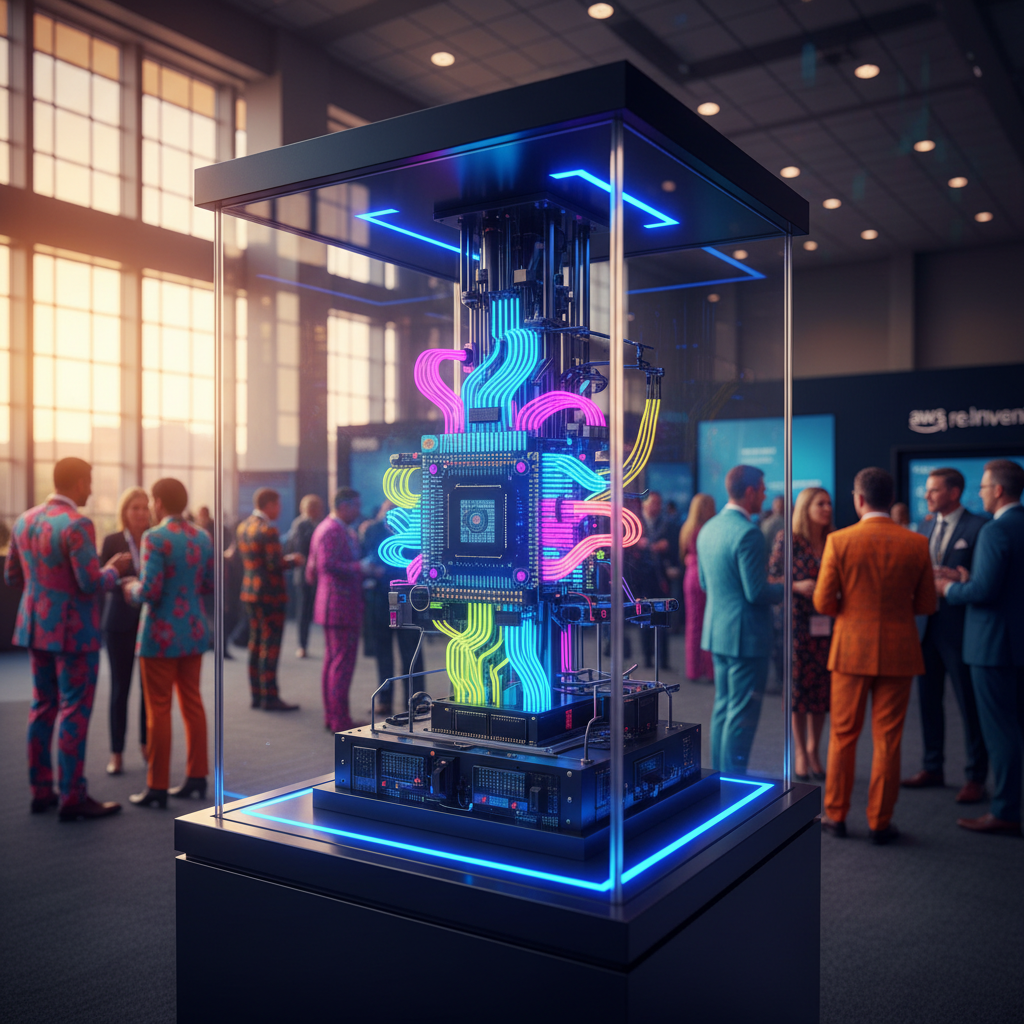
LAS VEGAS - As the curtains closed on AWS re:Invent 2025 this week, the narrative surrounding quantum computing shifted decisively from theoretical physics to industrial utility. Amazon Web Services (AWS) utilized its annual conference to consolidate a year of aggressive hardware and software advances, headlined by the integration of its proprietary "Ocelot" quantum chip and a strategic pivot toward hybrid quantum-classical workflows.
The developments, aimed squarely at CTOs and enterprise researchers, suggest that the cloud giant is moving to bridge the "utility gap"-the chasm between current noisy quantum hardware and fully fault-tolerant systems. By focusing on error-corrected architecture and seamless cloud integration, AWS is positioning its quantum services not as a replacement for classical computing, but as a specialized accelerator within existing high-performance computing (HPC) pipelines.

"Quantum computing is moving from research labs into early real-world use," an AWS spokesperson noted during the event, signaling a transition that analysts have awaited for arguably a decade. The announcements come amidst a broader $50 billion investment by AWS in AI and supercomputing infrastructure, underscoring the convergence of these advanced technologies.
The Ocelot Architecture: A Hardware Leap
Central to the discussions at re:Invent 2025 was the Ocelot chip, originally unveiled in February 2025. The architecture represents a divergence from the standard qubit designs pursued by competitors. AWS has focused on bosonic qubits, an approach detailed in a 2025 paper published in Nature, which demonstrated the first experimental logical qubit using this method.
According to Oskar Painter, AWS Director of Quantum Hardware, the Ocelot architecture addresses the most significant barrier to commercial viability: error correction. Current quantum systems require thousands of physical qubits to create a single logical (error-free) qubit, a ratio that makes scaling prohibitively expensive.
"In the future, quantum chips built according to the Ocelot architecture could cost as little as one-fifth of current approaches, due to the drastically reduced number of resources required for error correction," Painter stated. "Concretely, we believe this will accelerate our timeline to a practical quantum computer by up to five years."
This efficiency is critical for enterprise adoption. By reducing the overhead required for error correction, AWS aims to lower the barrier to entry for sectors like pharmaceuticals and materials science, where the cost of simulation is a key constraint.
Accelerating Research with Amazon Braket
While hardware provides the engine, software provides the steering. AWS announced significant upgrades to Amazon Braket, its fully managed quantum computing service, designed to speed up the iterative process of research.
A key feature highlighted was "program sets," introduced in late 2025. This capability allows researchers to run quantum algorithms up to 24 times faster on supported devices when executing hundreds of circuits. This batch processing capability is vital for variational quantum algorithms, which are often used in chemical simulations and optimization problems and require rapid feedback loops between classical and quantum processors.
Furthermore, the ecosystem continues to expand. Alpine Quantum Technologies (AQT) recently launched its quantum computer on Amazon Braket, providing customers with diverse hardware options. This multi-vendor approach contrasts with some competitors who lock users into a single hardware architecture, offering AWS customers the flexibility to test their algorithms across different qubit modalities.
Bridging the Hybrid Gap
The introduction of tools like "Palace" (Parallel, Large-scale Computational Electromagnetics) signifies AWS's intent to dominate the simulation market. Palace is a parallel finite element code used for full-wave electromagnetics simulations, now optimized for the cloud. By integrating such high-level simulation tools with quantum backends, AWS is effectively blurring the lines between classical supercomputing and quantum processing.
Security and the Post-Quantum Transition
Beyond computation, the security implications of quantum advancements were a major theme at re:Invent 2025. With regulators expecting quantum-safe measures to be enforced by 2030, and compliance deadlines for regulated industries appearing as early as 2027, the clock is ticking for data protection standards.
AWS highlighted its collaboration with Accenture to accelerate the transition to post-quantum cryptography (PQC). This partnership aims to help organizations audit their cryptographic inventory and migrate to quantum-resistant algorithms before cryptographically relevant quantum computers (CRQCs) become a threat to current encryption standards.
"Systemic upgrades can take years-organizations need to begin upgrading now," AWS warned in a joint statement with Accenture. This defensive posture complements the offensive capabilities of the Ocelot chip, providing a holistic "quantum readiness" strategy for enterprise clients.
Competitive Context and Outlook
The announcements at re:Invent 2025 place AWS in direct contention with other tech titans. Google recently claimed reduced error rates with its "Willow" processor, and Microsoft continues to advance its topological qubit research. However, AWS's strategy appears distinct in its emphasis on cloud integration and cost reduction through the Ocelot architecture.
Market analysts at Constellation Research noted that practical development in quantum computing has "accelerated into 2025," with the focus shifting from raw qubit counts to logical error rates and system integration. AWS's claim that Ocelot could shave five years off the development timeline is a bold assertion that, if proven true, could reshuffle the leadership board of the quantum industry.
As the technology matures, the implications for government and industry are profound. The recent $50 billion AWS investment in infrastructure for government customers indicates that the public sector will be a primary early adopter, likely utilizing these hybrid systems for complex logistics, code-breaking, and material science for defense applications.
For the enterprise decision-maker, re:Invent 2025 offered a clear message: the quantum era is no longer a distant horizon. It is a developing operational layer within the cloud stack, requiring immediate strategic attention regarding both computational opportunity and cryptographic security.


