


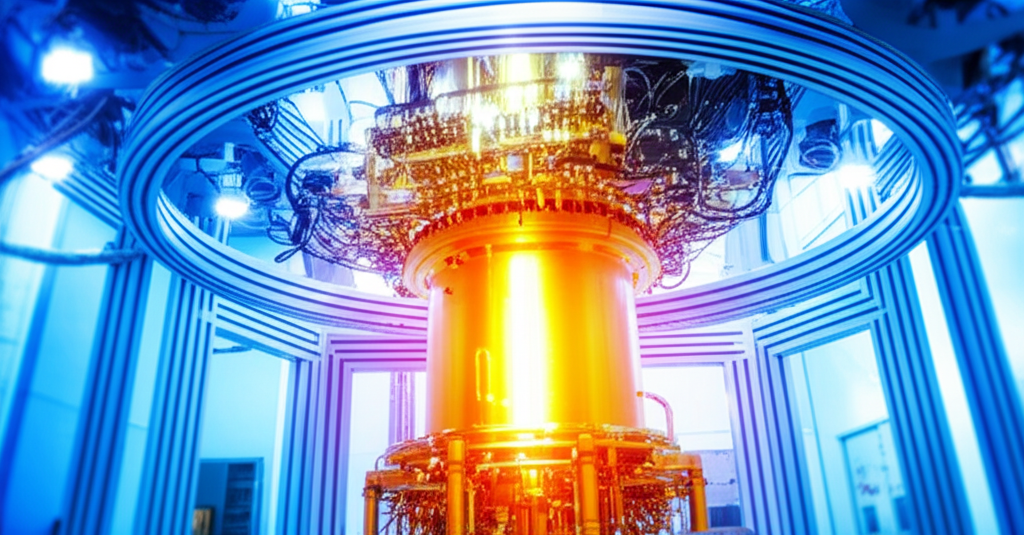
NEW YORK - In a defining moment for the emerging quantum technology sector, IBM has officially staked its claim on the immediate future of high-performance computing, announcing a concrete timeline to achieve "quantum advantage" by the end of 2026. The announcement, made alongside the unveiling of its new "Nighthawk" processor and "Loon" lattice architecture, signals a shift from experimental physics to commercial urgency. According to executives speaking at the company's developer conference in late 2025, the new hardware lays the groundwork for the wider community to mathematically prove that quantum systems can outperform classical supercomputers on practical tasks within the next 12 to 18 months.
The roadmap update places IBM in a direct race against sovereign efforts and tech giants like Google and Amazon, but with a distinct focus on enterprise scalability. By committing to a fault-tolerant system-one capable of correcting its own calculation errors-by the end of 2029, IBM is effectively putting global industries on notice: the era of theoretical quantum computing is ending, and the era of operational risk and opportunity has begun.
Nighthawk and the Path to 2026
Central to IBM's aggressive timeline is the release of the Nighthawk quantum processing unit (QPU). Reports confirm that the Nighthawk processor is engineered to handle circuits with significantly higher complexity than its predecessors. Specifically, the chip features 120 qubits linked by 218 next-generation tunable couplers arranged in a square lattice topology. This architecture offers approximately 30% greater complexity handling and 20% better connectivity than the previous Heron processor.

Complementing the Nighthawk chip is the "Loon" lattice architecture, which is expected to be fabricated and assembled by the end of 2025. According to industry analysts, testing for Loon will commence in early 2026. This architecture is designed to implement and scale components necessary for practical, high-efficiency quantum error correction-the "holy grail" of reliable quantum computing.
"IBM announced it had lain the groundwork for enabling the community to achieve quantum advantage next year and for a fully fault-tolerant quantum computing system by the end of 2029," noted technology analyst Karl Freund in a report for Forbes.
The Security Imperative: 'Y2Q' Approaches
While the hardware advancements promise breakthroughs in materials science and logistics, the implications for cybersecurity are stark. The arrival of capable quantum machines threatens to break the public-key encryption standards that currently secure the global financial system and government communications.
Experts estimate that commercial actors could possess the ability to break standard digital signatures by 2032 if current development timelines hold. Consequently, the window for migration to Post-Quantum Cryptography (PQC) is closing. IBM has explicitly advised that organizations need to transition to PQC standards by 2030 to mitigate these risks. This timeline suggests a mere four to five years for global enterprises to overhaul their cryptographic infrastructure, a massive undertaking comparable to the Y2K preparations of the late 1990s.
Global Readiness and Collaboration
The race for quantum dominance is not occurring in a vacuum. Cross-border collaborations are accelerating as nations vie for position in the quantum supply chain. In Japan, IBM has integrated its systems with RIKEN, a leading research institute, where early users are reportedly seeing significant results. Furthermore, partnerships with software providers like Q-CTRL are expanding the utility of these systems, integrating performance-management technology to support a broader range of hardware, including ion-trap machines.
However, a gap remains between technological capability and organizational readiness. The IBM Institute for Business Value's "2025 Quantum Readiness Index" highlights that while the hardware is maturing, many commercial sectors lag in their preparedness to leverage-or defend against-quantum technologies. Who captures this potential, and who is left behind, will likely be determined by the strategic decisions made in boardrooms over the next 24 months.
Looking Ahead: The Road to 2029
The immediate focus for 2026 is the demonstration of quantum advantage-performing a specific task better than any classical computer. Beyond that, the goal posts shift to 2029, the target year for a fully fault-tolerant system. This would mark the maturation of the technology into a stable industrial tool.
To support this trajectory, IBM has also implemented RelayBP on AMD FPGAs, achieving decoding speeds approximately an order of magnitude faster than leading industry solutions. Such hybrid integration between quantum processors and classical high-performance computing is critical for the error correction required at scale.
As the 2025 roadmap concludes, the message to the market is unambiguous: Quantum computing is no longer a "what if" scenario for the distant future. With hardware like Nighthawk entering the commercial cloud, the technology has crossed the threshold from scientific curiosity to strategic necessity.


