


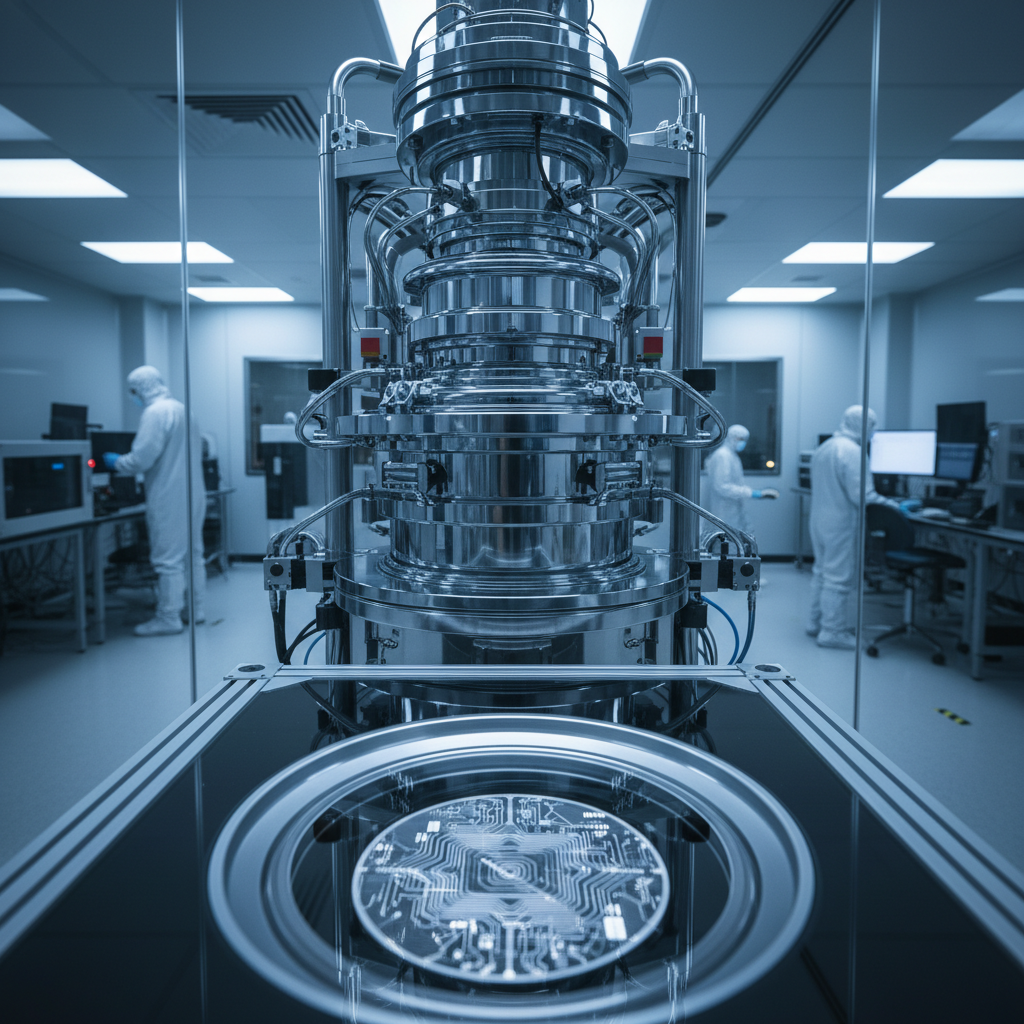
CHICAGO - In a development that could significantly accelerate the timeline for fault-tolerant quantum computing, EeroQ has announced a hardware breakthrough addressing one of the industry's most persistent engineering hurdles: the wiring bottleneck.
According to reports released on January 16, 2026, the Chicago-based company has successfully demonstrated a control architecture capable of managing up to one million qubits using fewer than 50 physical control lines. This advancement effectively bypasses the linear scaling constraints that have long plagued superconducting and other solid-state quantum approaches, where the number of wires typically grows in lockstep with the number of qubits.
By utilizing electrons trapped on the surface of superfluid helium, EeroQ's approach leverages standard CMOS manufacturing to achieve high connectivity without the thermal load and physical clutter of thousands of coaxial cables. The breakthrough signals a shift from experimental physics to viable industrial engineering.

Breaking the Interconnect Barrier
For the past decade, the quantum computing sector has struggled with the "wiring problem." As researchers attempted to scale processors from dozens to hundreds of qubits, the sheer volume of control wiring required to manipulate each qubit introduced unmanageable heat and interference, destabilizing the fragile quantum states.
"With this result, EeroQ has shown a path forward that will allow for much easier scalability and fewer errors," said Nick Farina, co-founder and CEO of EeroQ. "We have demonstrated a low-cost, practical path to scaling from thousands of electrons today to millions of electron spin qubits in the future."
This announcement follows a series of strategic milestones for the company. In October 2025, EeroQ published research in Physical Review X demonstrating the control of single electrons at temperatures exceeding 1 Kelvin-more than 100 times hotter than the near-absolute-zero temperatures required by competitors like IBM or Google. Operating at higher temperatures significantly reduces the cooling power overhead, further simplifying the hardware stack.
Strategic Investment and Market Momentum
The technical validation has already attracted significant capital interest. In December 2025, SEALSQ Corp (NASDAQ: LAES) announced a strategic investment in EeroQ as part of its "Quantum Made in USA" initiative. This partnership aims to integrate EeroQ's chip designs with broader semiconductor manufacturing capabilities, reinforcing a domestic supply chain for critical quantum technologies.
Market analysts suggest that 2025 was a pivotal transition year for the industry. While pure-play companies like D-Wave and IonQ saw stock surges of 3,700% and 700% respectively over the trailing year, the focus has shifted from qubit count to qubit quality and system manageability. EeroQ's ability to fit millions of electrons on a single chip without modular complexity positions it uniquely in this evolving landscape.
The Engineering Advantage
The core of EeroQ's technology relies on the purity of superfluid helium. Unlike solid-state silicon qubits, which suffer from material defects that cause errors, electrons on helium float in a vacuum above a pristine surface. This results in naturally high coherence times. The recent demonstration proves that these electrons can be shuttled and controlled using standard voltage gates similar to those in classical transistors.
"This innovation allows for millions of qubits on a single chip, overcoming many challenges other quantum systems face," noted Brad Fingland, Director of Venture Creation for the MSU Research Foundation. By leveraging existing chip fabrication technology, the company avoids the need for exotic manufacturing processes.
Future Outlook and Commercial Implications
As the quantum sector moves toward 2026, the distinction between theoretical potential and engineering reality is widening. EeroQ's architecture suggests a roadmap where the physical size of a million-qubit processor remains compact, potentially fitting within standard server rack dimensions rather than filling a warehouse.
However, challenges remain. While control wiring has been simplified, high-fidelity two-qubit gates and error correction protocols must still be proven at scale. Yet, by removing the physical wiring barrier, EeroQ has cleared the runway for these next-generation developments.
For enterprise stakeholders, this development implies that useful quantum advantage-particularly in materials science and chemistry simulation-may arrive sooner than the conservative estimates of the 2030s. As the "Quantum Made in USA" strategy gains traction, further government and private sector investment into CMOS-compatible quantum architectures is expected to accelerate.


