


The digital landscape is in constant flux, and as Director of Global Sales at IndiaNIC, I've witnessed firsthand how innovation can reshape entire industries. Today, we stand on the precipice of another profound transformation, one powered by the burgeoning capabilities of generative artificial intelligence. This isn't just an incremental update; it's a fundamental paradigm shift in how we conceive, design, and interact with digital products. We're moving beyond optimizing existing business cases to fundamentally inventing new ones, driven by AI's unique ability to interpret intent and generate outcomes.
For years, our digital interactions have been largely structured around a familiar hierarchy: Find, List, Select. Think about searching for a product on an e-commerce site, booking a flight, or even navigating a complex software interface. You'd search for keywords, browse through lists of results, and then make a selection. This model, while effective, is inherently linear and often requires considerable user effort to articulate their needs precisely. It places the onus on the user to understand the system's structure and to effectively translate their desire into searchable queries.
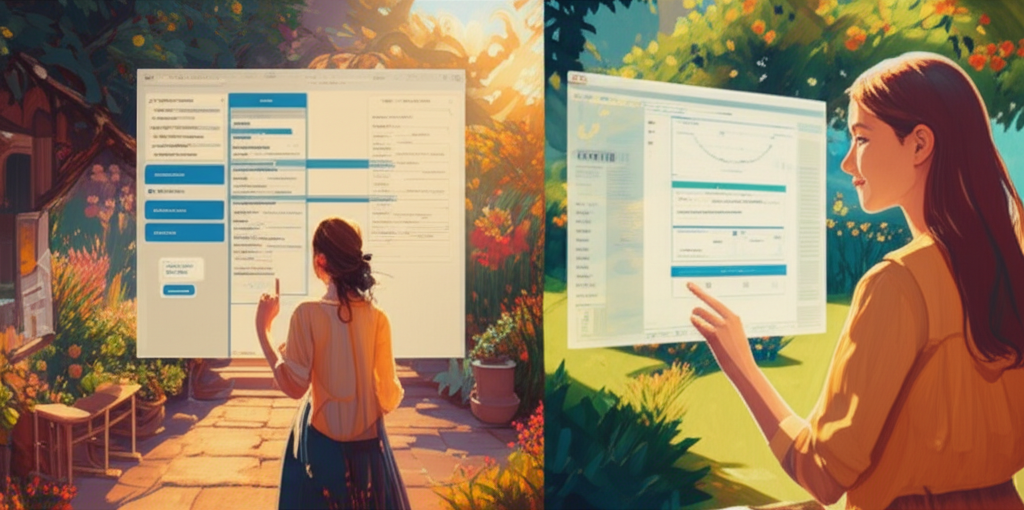
Generative AI, however, introduces a radically different approach: the 'Intent to Outcome' model. Instead of guiding users through predetermined paths and menus, AI can now directly interpret a user's underlying intent, even if it's vaguely expressed, and directly generate the desired outcome. This represents a monumental leap in user experience (UX) design, moving us towards interfaces that are not just intuitive, but anticipatory and dynamically assembled in real-time.
The Evolution: From Librarian to Director of Outcomes
Consider the user's role in this evolving ecosystem. Previously, we were akin to librarians, meticulously sifting through vast collections of information and static options to find what we needed. We navigated menus, filters, and dropdowns, patiently piecing together our desired outcome. This required a deep understanding of the 'library's' cataloging system - the UI's structure and logic.
The 'Intent to Outcome' paradigm shifts this role dramatically. Users are no longer passive sorters; they become directors. They articulate their vision, their desired end-state, and the AI, powered by sophisticated natural language processing and generative capabilities, acts as their production team, assembling the necessary components and delivering the final product. The UI, in this context, recedes into the background. It becomes a fluid, responsive intermediary that facilitates the seamless translation of intent into tangible, tailored solutions.
This shift is particularly evident in platforms like OpenAI's ChatGPT, where users can describe complex requests, from writing code snippets to drafting marketing copy, and receive immediate, relevant outputs. Similarly, image generation tools like Midjourney allow users to describe visual concepts and witness them brought to life, bypassing the need for intricate design software expertise.
The Central Tension: Servant or Innovator?
This brings us to a critical tension: Is generative AI's impact on UX merely a sophisticated servant to existing business cases, optimizing efficiency within established frameworks? Or do its unique capabilities, particularly its prowess in interpreting nuanced intent and generating novel outcomes, fundamentally invent entirely new business models and user experiences?
My experience at IndiaNIC has shown me that while optimizing existing processes is a valuable application, the true power of generative AI lies in its ability to unlock entirely new possibilities. We've seen clients who initially sought to automate their existing customer support FAQs find themselves, through AI-driven insights, redesigning their entire customer journey to be more proactive and personalized, thereby reducing support needs altogether.
The true innovation of generative AI in UX lies not in replicating existing user journeys more efficiently, but in enabling entirely new forms of interaction and value creation that were previously unimaginable.
This is where the 'zero-friction' interface concept comes into play. Imagine a scenario where you need to plan a complex multi-city business trip. Instead of navigating multiple booking sites, cross-referencing calendars, and manually inputting data, you might simply state, "Plan a business trip to London and Paris next week, prioritizing efficient travel between cities and ensuring I can attend a client meeting in Paris on Wednesday morning." The AI would then dynamically assemble the itinerary, including flights, accommodation, and even potential meeting venues, all in real-time, presenting a finalized, actionable plan. This dynamic assembly eliminates the friction points that currently plague such complex tasks.
Strategic Implications for Product Leaders and Designers
Navigating this non-deterministic future requires a significant strategic recalibration for product leaders and designers. The reliance on fixed, pre-defined user flows and rigid UI elements is diminishing. Instead, the focus must shift towards understanding user intent at a deeper, more contextual level.
Navigating the New Design Paradigm
Here are key considerations for product teams:
- Embrace Ambiguity: Design for flexibility and adaptability. User inputs will be less precise, and outputs will need to be generated dynamically.
- Focus on Intent Mapping: Develop sophisticated mechanisms for understanding the underlying goals and desires behind user prompts. This involves leveraging advanced NLP and context awareness.
- Design for Iteration and Refinement: The first AI-generated outcome may not be perfect. The UI should facilitate easy iteration and refinement based on user feedback.
- Build Trust through Transparency: Clearly communicate how AI is being used and provide users with control over the generative process.
- Explore New Business Models: Think beyond optimizing existing revenue streams. How can AI-driven outcomes create entirely new markets or service offerings?
In my 20+ years in the digital solutions space, I've seen numerous technological shifts, but few have held the transformative potential of generative AI in UX. It's a journey that moves us away from simply providing tools to facilitating genuine creation and problem-solving, all within an increasingly frictionless digital environment.
For instance, I recall a project from several years ago where we were developing an intricate dashboard for financial analysts. The initial brief was to create a highly customizable interface with numerous charting options and data filters. While we delivered a powerful tool, the user adoption was challenging because the sheer number of options was overwhelming. The analysts knew what insights they needed, but navigating the interface to find them was a constant hurdle. Today, with generative AI, we could envision an interface where analysts describe their analytical question, and the AI generates the relevant visualizations and data points, bypassing the manual configuration entirely. This would have been a game-changer for that project.
The Data-Driven Shift
The market is already reflecting this shift. Businesses are recognizing the potential for AI to not only enhance efficiency but also to unlock new revenue streams. According to a 2024 report by Gartner, "Generative AI will become a key driver of digital transformation, enabling hyper-personalization and accelerating the creation of new digital products and services."
Here's a glimpse into the projected growth and impact:
| Metric | 2023 (Estimated) | 2027 (Projected) | Compound Annual Growth Rate (CAGR) |
|---|---|---|---|
| Global Generative AI Market Size | $40.1 Billion | $450.5 Billion | 32.2% |
| AI-driven Personalization Adoption | 45% | 70% | 13.8% |
| Customer Satisfaction with AI Support | 60% | 85% | 15.2% |
Source: Various industry reports and projections for 2023-2027.
This data underscores the rapid adoption and anticipated exponential growth, confirming that the shift towards AI-driven, intent-focused UX is not a distant future but a present reality demanding immediate strategic attention.
The Non-Deterministic Future
The 'Intent to Outcome' model ushers in a non-deterministic future for digital product design. Unlike deterministic systems where every input leads to a predictable output, AI-driven generative systems introduce an element of emergent behavior. This means we must design for exploration, for delightful surprises, and for collaborative co-creation between human and machine.
For product leaders and designers, this era calls for a blend of technical acumen, creative foresight, and a profound understanding of human psychology. It requires us to move beyond rigid blueprints and embrace a more fluid, adaptive approach to building digital experiences that truly empower users by anticipating their needs and transforming their intent into reality with unprecedented ease.
The journey from 'Find, List, Select' to 'Intent to Outcome' is an exciting one. It promises a future of digital interactions that are more intuitive, more efficient, and ultimately, more human-centric. At IndiaNIC, we are committed to helping brands navigate this evolution, crafting digital products that not only meet current demands but also pioneer the experiences of tomorrow.


