
Let me tell you something most people in our industry are hesitant to admit: true innovation in IT services isn't about chasing the latest buzzwords; it's about forging partnerships that fundamentally alter how we deliver value. The recent announcement of LTIMindtree's strategic alliance with Anthropic is not just another tech collaboration; it's a seismic shift that redefines the very landscape of enterprise AI adoption for IT services firms, especially for us mid-size players looking to punch above our weight.
The Genesis of AI-Infused Service Delivery
For years, the promise of AI in IT services felt like a distant star. We talked about efficiency gains, smarter automation, and better insights, but often, the implementations were piecemeal, siloed, and failed to unlock the transformative potential we envisioned. The challenge wasn't the technology itself, but its seamless integration into our core delivery fabrics - the systems and processes that power our client engagements day in and day out. This is precisely why the LTIMindtree and Anthropic partnership is so pivotal. It's not just about adopting an AI model; it's about embedding it into a comprehensive delivery framework like LTIMindtree's BlueVerse AI Delivery Fabric. This approach recognizes that AI's true power lies not in isolation, but in its ability to augment human capabilities across the entire service lifecycle. My own journey, leading IndiaNIC through its own growth phases, has taught me that significant leaps don't come from incremental improvements. They come from embracing foundational shifts, and this is one such shift.
The integration of Anthropic's advanced AI models - Claude, Claude Code, and Claude Cowork - into BlueVerse signifies a move from AI as a tool to AI as an intrinsic element of service. Claude's advanced reasoning and conversational abilities, Claude Code's specialized proficiency in generating and understanding code, and Claude Cowork's potential for enhancing team collaboration are not merely features; they are potential game-changers. They address critical pain points in service delivery: accelerating development cycles, improving code quality, and fostering more effective knowledge sharing. For mid-size IT services firms like mine, this means leveling the playing field. We can now aspire to deliver a level of sophistication and efficiency that was once the exclusive domain of much larger entities. The key is not just having access to AI, but having it intelligently woven into your operational DNA. This partnership promises exactly that, providing a blueprint for how AI can be architected for maximum impact.
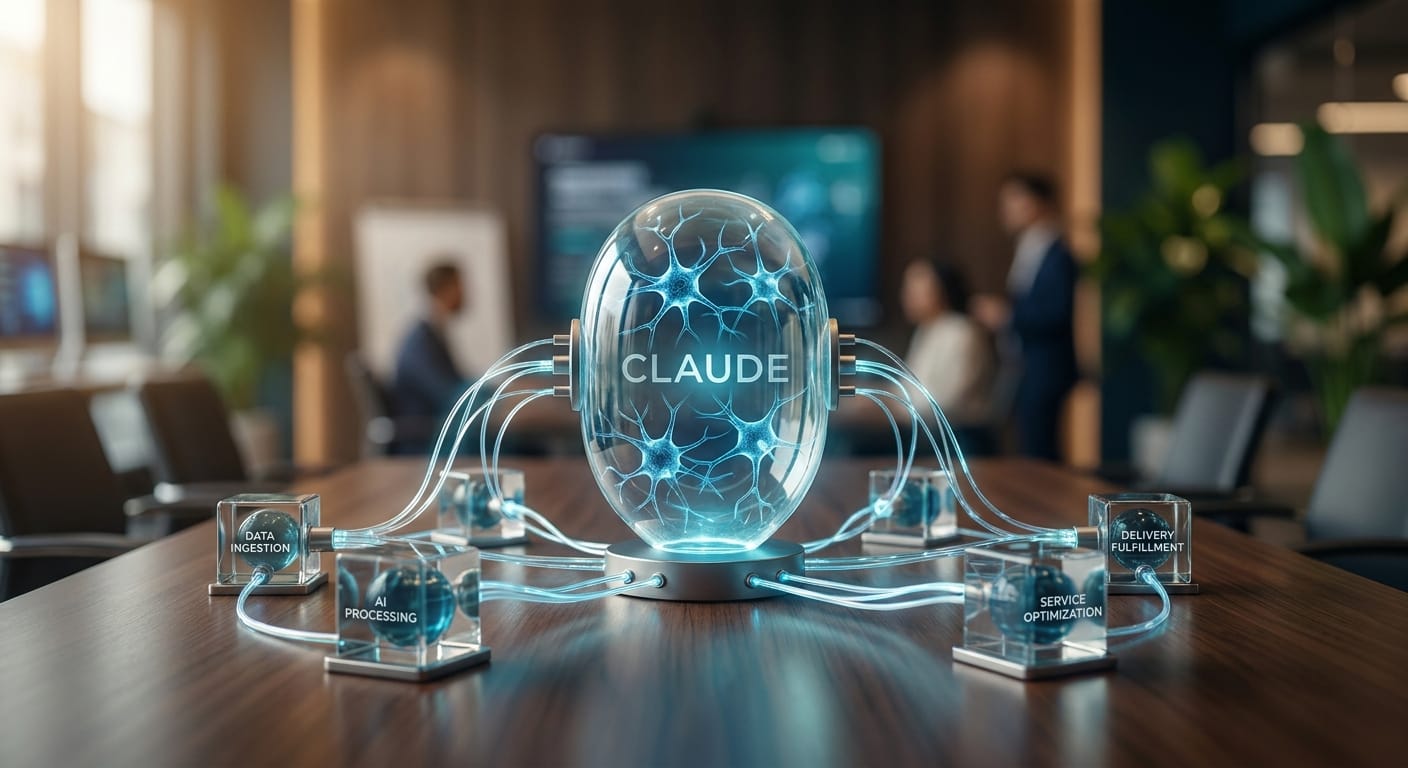
A Framework for AI-Powered Transformation
To truly grasp the implications, we need a clear mental model. I've found it useful to think of this evolution in three interconnected layers: Augmented Intelligence, Accelerated Workflow, and Advanced Collaboration. This framework helps demystify how sophisticated AI integrations like the one between LTIMindtree and Anthropic can reshape IT services.
The first layer, Augmented Intelligence, is about using AI to enhance the cognitive capabilities of our teams. This means leveraging models like Claude to provide context-aware answers to complex client queries, synthesize vast amounts of technical documentation, or even assist in strategic decision-making by identifying patterns and potential risks. It's about moving beyond simple automation to intelligent assistance.
The second layer, Accelerated Workflow, focuses on how AI can dramatically speed up our operational processes. Claude Code, for instance, is poised to revolutionize coding. Instead of spending hours writing boilerplate code, debugging, or searching for solutions on forums, developers can leverage AI to generate code snippets, identify vulnerabilities, and even suggest optimizations. This not only speeds up development but also frees up our engineers to focus on more complex, creative problem-solving.
Finally, Advanced Collaboration is where AI fosters seamless teamwork and knowledge sharing. Claude Cowork, in its envisioned capacity, can act as an intelligent assistant for teams, summarizing project updates, facilitating brainstorming sessions, and ensuring that institutional knowledge is readily accessible to everyone. This reduces knowledge silos and ensures that project continuity isn't dependent on individuals. This three-layered framework - Augmented Intelligence, Accelerated Workflow, and Advanced Collaboration - is what makes the LTIMindtree-Anthropic alliance so compelling. It's not just about a single AI tool, but a holistic approach to embedding intelligence into every facet of service delivery.
Unpacking the Impact: From Code to Client Engagement
Let's drill down into the practical implications. Consider the development lifecycle. Traditionally, a significant portion of an IT professional's time is spent on understanding requirements, writing code, testing, and documentation. The integration of Claude Code into the BlueVerse fabric can transform this. Imagine a scenario where a developer is tasked with building a new microservice. Instead of starting from scratch, they can brief Claude Code on the requirements, and it can generate initial code structures, API endpoints, and even unit tests. This isn't about replacing developers; it's about empowering them with a highly sophisticated co-pilot. My own experience has shown that the most significant productivity gains come when technology removes the mundane, allowing human ingenuity to shine. We've seen this with cloud adoption, and we'll see it again with AI.
Beyond coding, think about client interactions. Claude's ability to process natural language and generate coherent, contextually relevant responses can significantly enhance customer support and managed services. For instance, when a client reports an issue, Claude can analyze the problem description, cross-reference it with historical data and documentation, and provide potential solutions or diagnostic steps to the support engineer, often within seconds. This not only resolves issues faster but also improves client satisfaction.
A real-world example that resonates with me: A few years back, we were working on a complex migration project for a client. The sheer volume of legacy documentation was overwhelming, and finding specific technical details was a daily struggle for the team. We eventually implemented a knowledge management system, but it was clunky and required manual indexing. Had we had something akin to Claude Cowork integrated into our project management tools then, the effort would have been drastically reduced. Imagine an AI that could automatically summarize daily stand-ups, highlight action items, and proactively surface relevant design documents when a particular discussion arises. That's the promise Anthropic's models bring to the BlueVerse fabric, and it's a game-changer for project efficiency and knowledge retention.
Here's a look at some potential impacts based on industry trends and projections:
| Area of Impact | Current State (Typical) | AI-Integrated State (Projected) | Projected Improvement (%) |
|---|---|---|---|
| Code Development Time | 100% | 60-70% | 30-40% |
| Incident Resolution Time | 100% | 70-80% | 20-30% |
| Knowledge Retrieval Efficiency | 100% | 50-60% | 40-50% |
| New Skill Acquisition (Developers) | Months | Weeks (assisted) | Significant acceleration |
These figures, while projections, are based on early adoption trends and the known capabilities of advanced AI models. According to Gartner, the adoption of generative AI in enterprise IT is expected to accelerate significantly, with estimates suggesting a substantial increase in productivity across various roles by 2025.
The Mid-Size Advantage: Navigating the AI Frontier
For mid-size IT services firms, this partnership isn't just about adopting new technology; it's about strategic positioning. In the past, large IT conglomerates had the resources to invest heavily in proprietary AI research and development, creating a competitive moat. Now, with powerful AI models and platforms becoming more accessible through strategic alliances like this, mid-size firms can leverage cutting-edge capabilities without the astronomical upfront investment. This democratizes access to advanced AI.
My experience as CEO of IndiaNIC has shown me that agility and a willingness to experiment are our greatest assets. While larger firms can sometimes be bogged down by bureaucracy, we can adapt more quickly. The LTIMindtree-Anthropic collaboration offers a clear pathway for us to integrate advanced AI into our BlueVerse-like fabrics, enhancing our competitive edge. It means we can offer clients services that are not only cost-effective but also technologically superior, delivered with a speed and precision that rivals the biggest players. This is our opportunity to redefine what mid-size means in the global IT services arena - moving from being service providers to strategic AI-powered partners.
The true test of leadership in the AI era isn't about owning the most advanced algorithms, but about skillfully integrating them to unlock human potential and drive tangible business outcomes for clients. This partnership exemplifies that principle.
However, it's not without its challenges. My initial inclination might be to jump headfirst into adopting every new AI tool. But that's a mistake. We've learned the hard way that without a clear strategy, without understanding the underlying data governance, security implications, and ethical considerations, AI can become more of a liability than an asset. This is why the structured approach, integrating these powerful models within a robust delivery fabric like BlueVerse, is crucial. It's about responsible AI adoption, not just rapid deployment. We must be demanding of the technology, yes, but more importantly, we must be demanding of ourselves in how we implement it, ensuring it aligns with our clients' objectives and our own ethical standards. The path forward requires careful planning, continuous learning, and a commitment to a human-centric approach to AI integration.
Your Action Plan for AI Readiness
So, what can you do today to prepare for this AI-driven future in IT services? Here's a practical, actionable plan:
- Assess Your Current AI Readiness: Conduct an honest evaluation of your existing technology infrastructure, team skill sets, and data governance practices. Identify gaps where advanced AI integration could provide the most significant impact.
- Educate Your Teams: Invest in training for your engineers, project managers, and client-facing staff on AI concepts, ethical considerations, and the specific capabilities of models like Claude. Foster a culture of continuous learning.
- Develop a Pilot Project Strategy: Don't try to overhaul everything at once. Identify a specific service delivery area or workflow where you can pilot the integration of AI tools. Focus on measurable outcomes.
- Explore Strategic Partnerships: Look for collaborations with AI providers or consultancies that can help you navigate the complexities of integration, much like LTIMindtree has with Anthropic. Consider how platforms like BlueVerse can be adapted or replicated.
- Prioritize Ethical AI and Data Governance: Establish clear guidelines for AI usage, data privacy, and security. This is non-negotiable and will build trust with your clients and stakeholders.
The integration of Anthropic's Claude models into LTIMindtree's BlueVerse AI Delivery Fabric is a pivotal moment for the IT services industry. It offers a blueprint for how enterprise AI adoption can be strategically implemented to drive efficiency, innovation, and competitive advantage. For mid-size firms, this is not a threat, but an unprecedented opportunity. Embrace this evolution wisely, and you can redefine your place in the global tech ecosystem.
What are your thoughts on the future of AI in IT services? I'd love to hear your perspectives on how companies can best leverage these transformative technologies. Let's start a conversation about building the next generation of intelligent IT service delivery.
